Wired for Love
PBC Heart Pendant ❤︎
Tools
KiCAD, Easel, Carvey CNC Mill, Soldering Iron, 555 Timer Chip, Coin Cell Battery (CR2032), PCB Design Software
Skills
PCB layout design, Gerber file conversion, CNC milling, circuit design, component soldering, physical fabrication, technical documentation
*ba-dum ba-dum* heart racing!!!! Do you see your crush? Someone cute coming your way? Is it…
Wait no. That's not your heart. That is a PBC heart!
I designed and fabricated a heart-shaped PCB pendant powered by a 555 timer chip — combining PCB layout design, CNC milling, and soldering to create a heart that blinks like a heartbeat.
skip to final
⚙️
PROCESS
In the beginning, the schematic felt completely overwhelming — I couldn't see how something so technical could ever become something meaningful. But as I got more comfortable with the layout, I realized that within all the strict rules of a circuit, there was still space to play, to rearrange, to make it mine. Here are the steps I took to build my PCB Heart!
Building Steps
click on sections to skip
Designing the Schematic & Calculating Components
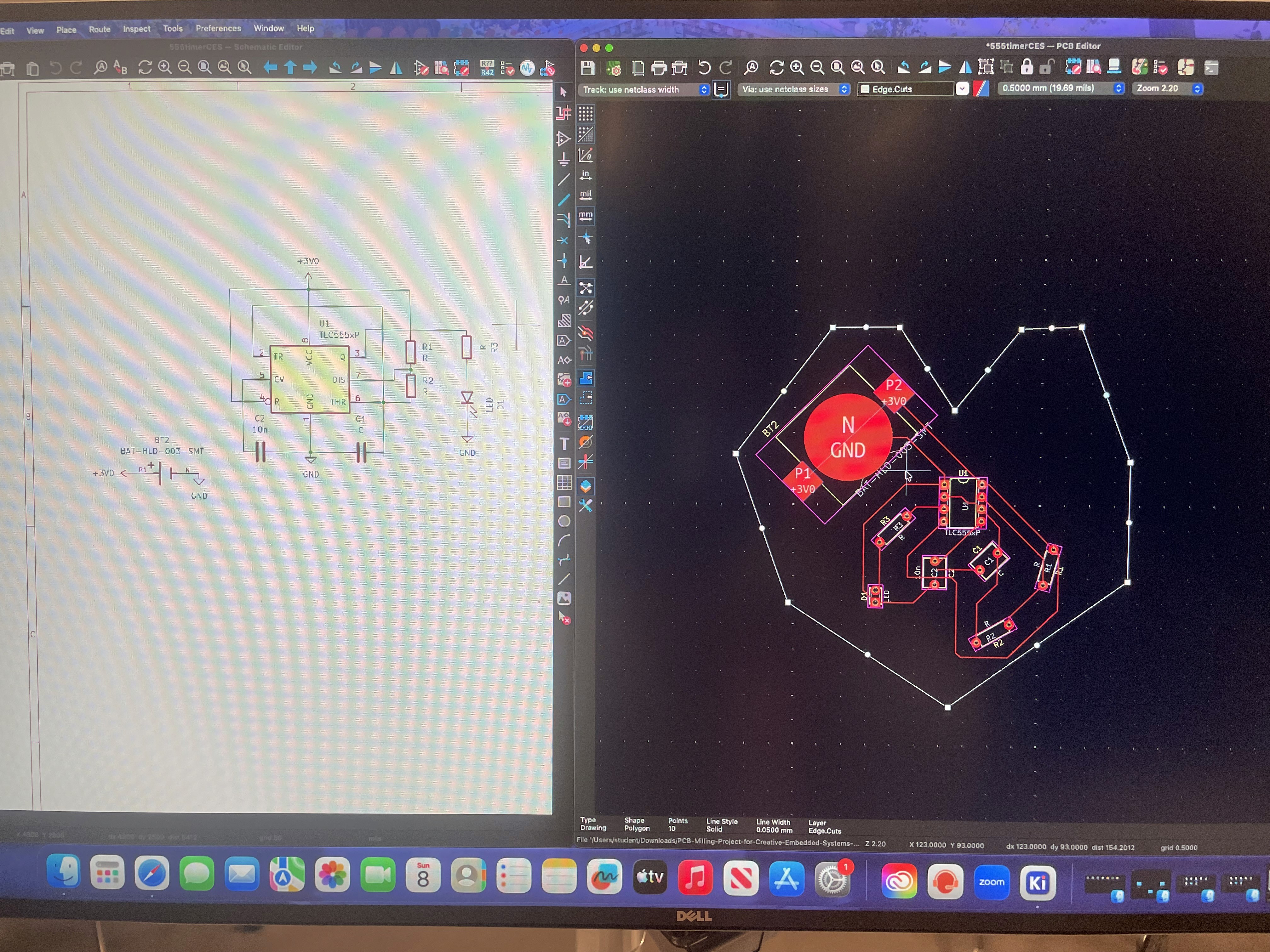
First, we needed to design the circuit schematic in KiCAD using the TLC555xP in astable mode. In class, we learned how component values control the blink frequency of the LED using the 555 astable formula:
f = 1.44 / (R1 + 2R2) × C1
With the given values of R1 = 4.7kΩ, R2 = 68kΩ, and C1 = 4.7μF, the LED blinks at:
f = 1.44 / (4,700 + 136,000) × 0.0000047 ≈ 2.15 Hz — a slow, steady pulse of about 2 blinks per second.
*fun fact: a resting heart rate is between 60 and 100 beats per minute! (so not 2😅 but lets keep going)*
We also learned that R3 = 470Ω limits the current through the LED to prevent it from burning out:
I = (Vcc - Vf) / R3 = (3V - 2V) / 470Ω ≈ 2.1mA
C2 = 10nF was included as a decoupling capacitor to stabilize the power supply and reduce electrical noise. From there, all the components were wired together in KiCAD to complete the schematic.
PCB Layout & Heart Outline
With the schematic complete, I moved into KiCAD to design my PCB layout. I mapped out the resistors, capacitors, 555 timer chip, and LED, then routed copper traces to connect them — making sure not to cross or violate any design rules. This took some trial and error. I mismatched some connections at first, but worked through the routing until the circuit was correct.
Once everything was connected, I drew a heart-shaped board outline using Edge.Cuts around all the components. I intentionally kept the edges rough and sharp — to preserve that industrial, hardware feel of the piece.
Exporting Gerber & Drill Files
With the PCB layout finalized, I exported the Gerber and drill files from KiCAD — the standard file format that tells the CNC machine exactly where to cut, drill, and mill. I then ran them through a shell script called pcb_to_easel.sh, which converted the files into SVGs that the Carvey CNC could read. A small but critical step that bridges the digital design and the physical fabrication.
You can check out my files in the GitHub repo below!
CNC Milling
With the files ready, it was time to bring the heart to life on the Carvey CNC mill. I loaded the SVGs into Easel and set the depth parameters before starting the cut.
This was a trial-and-error process. Unexpected variables kept coming up — the depth wasn't cutting through far enough, the board was shifting mid-mill. My traces needed several rounds of depth adjustments before they were deep enough to conduct properly. Through this, I learned that no matter how carefully you plan, hardware will always throw an unexpected variable at you. The most important thing to do isn't to over-obsess over a plan, but to know how to read the situation and adapt to the problem in real time.
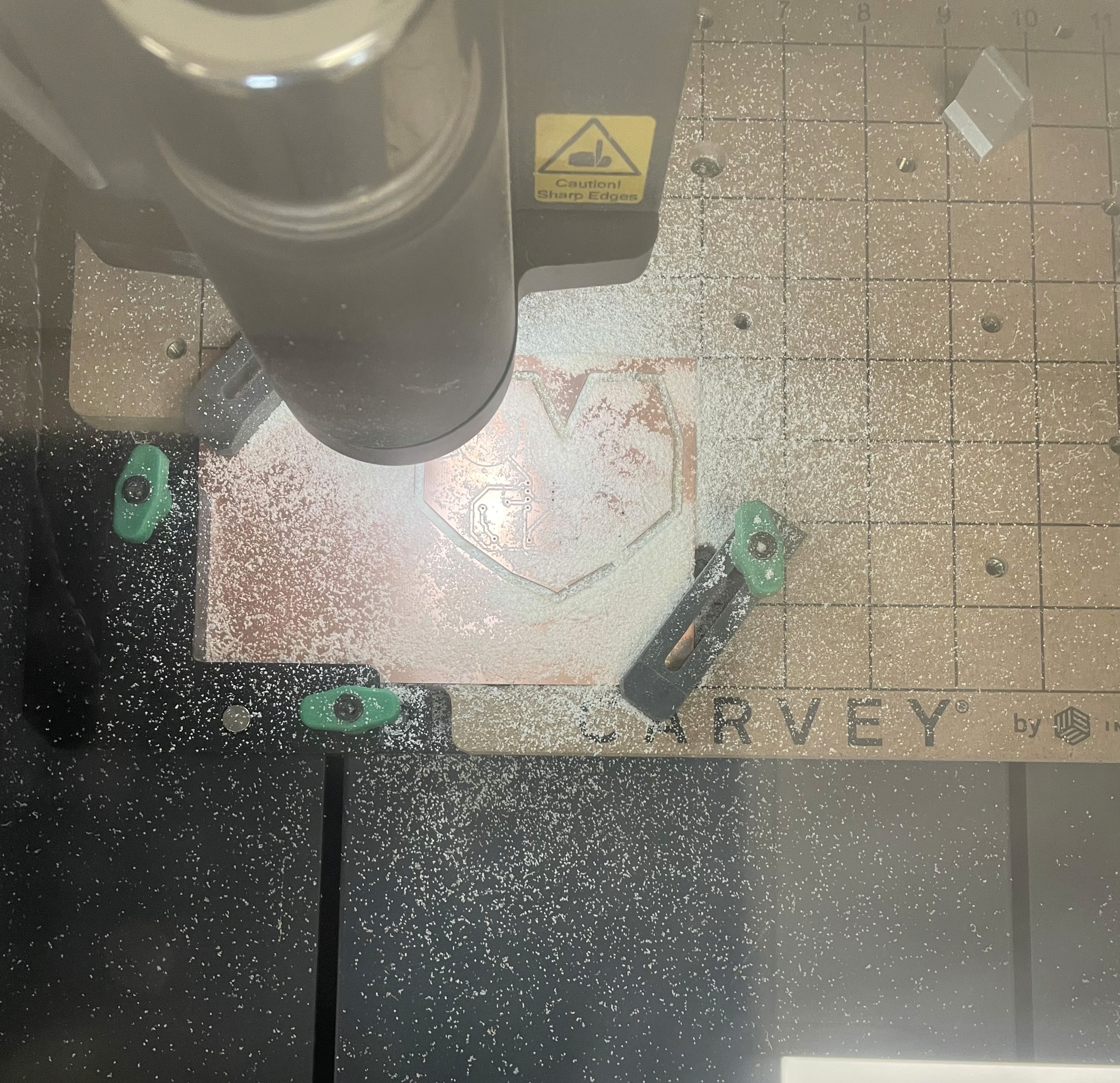
milling at work 🛠️
Soldering
With the board milled, it was time to solder. After the multiple humbling rounds on the first soldering project, this time felt noticeably easier — I was more comfortable with the iron and used the tricks I learned last time for smoother sailing this time around.
I projected my schematic in front of me and copied my layout design onto the board, component by component. Along the way, I picked up a few new tricks: bend the component leads on the underside of the board to hold them in place before soldering, and leave a small gap between the component and the board so a little wire is exposed for a strong grip. Both made the beads cleaner and the connections more secure.
And this time — I didn't need to restart 🙌!!!
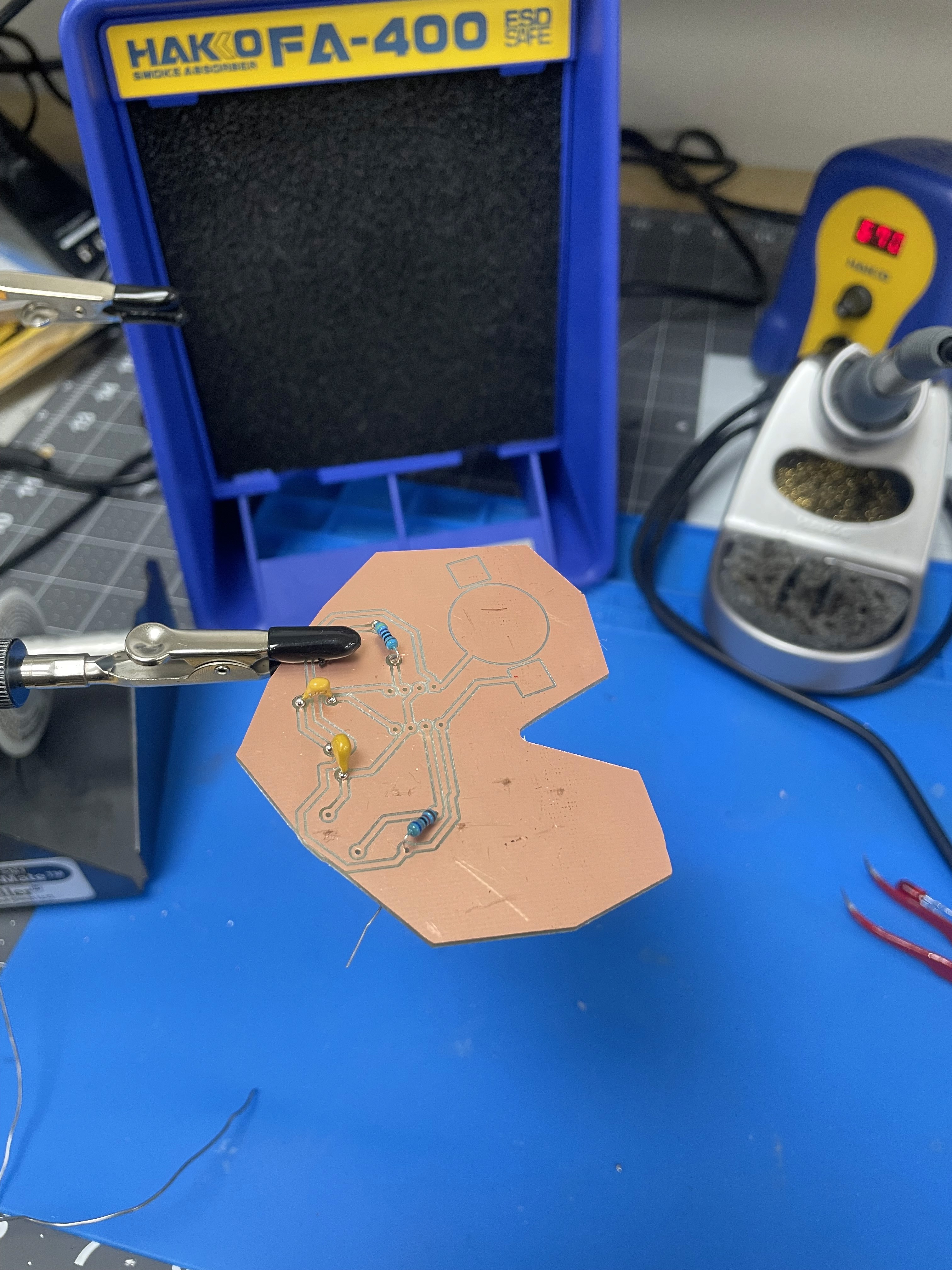
Light it UP!
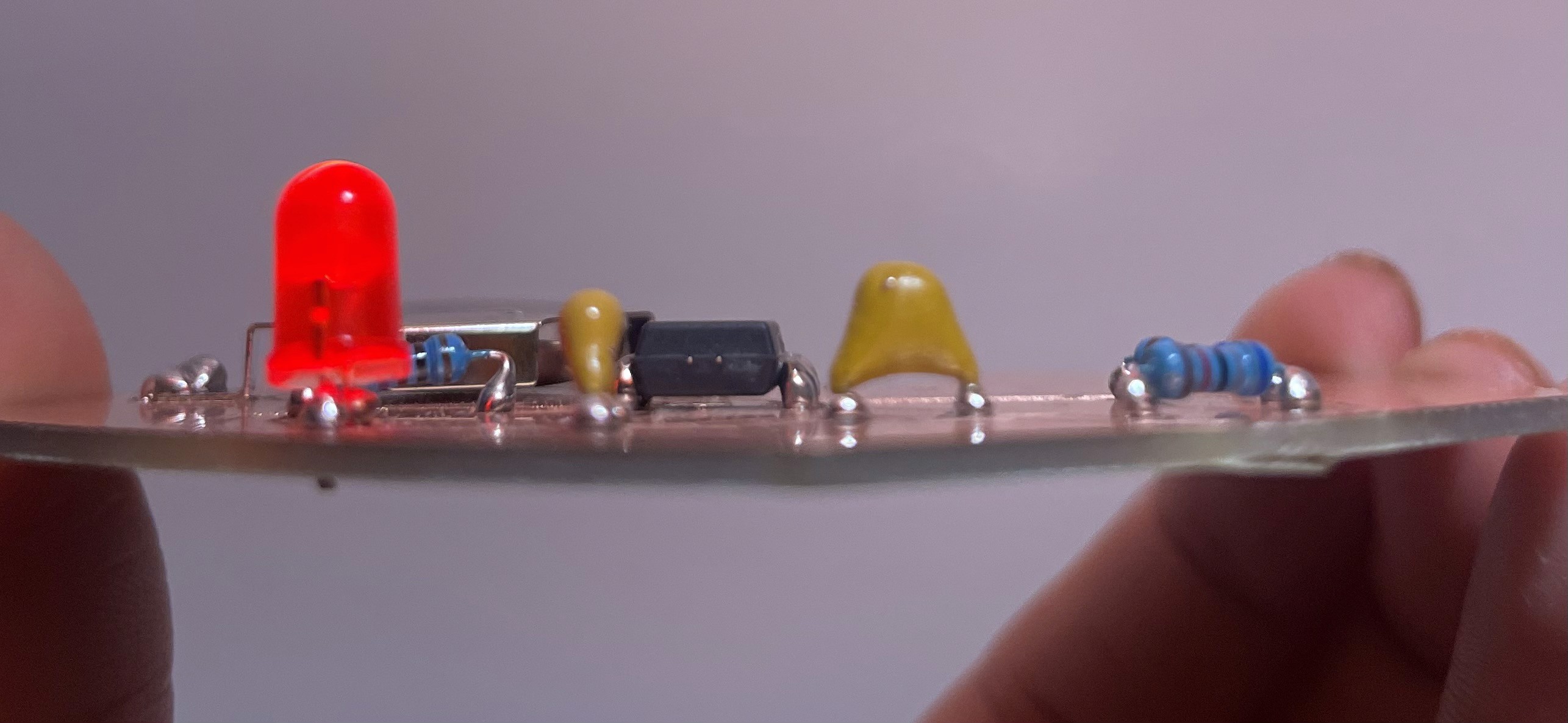
The moment of truth. I double-checked everything — making sure all components were soldered correctly, resistors were oriented the right way, and every connection was secure. Then I slid the CR2032 coin cell.
It blinked. The very first try! A slow, steady pulse at 2.15 Hz — exactly as calculated. A heartbeat was created❤️.
**Fun Fact!🤖**
The inventor of the first permanent artificial heart, Robert Jarvik, built it out of personal grief — his father was dying of heart disease, and he was trying to save him. Unfortunately, his father passed away before he could finish the heart. So he devoted the rest of his life to developing artificial hearts to make sure others would have a better chance. Sometimes the most robotic innovations come from the most humane places :).
beep-ba-dum-beep-boop
DETAIL SHOTS
📸
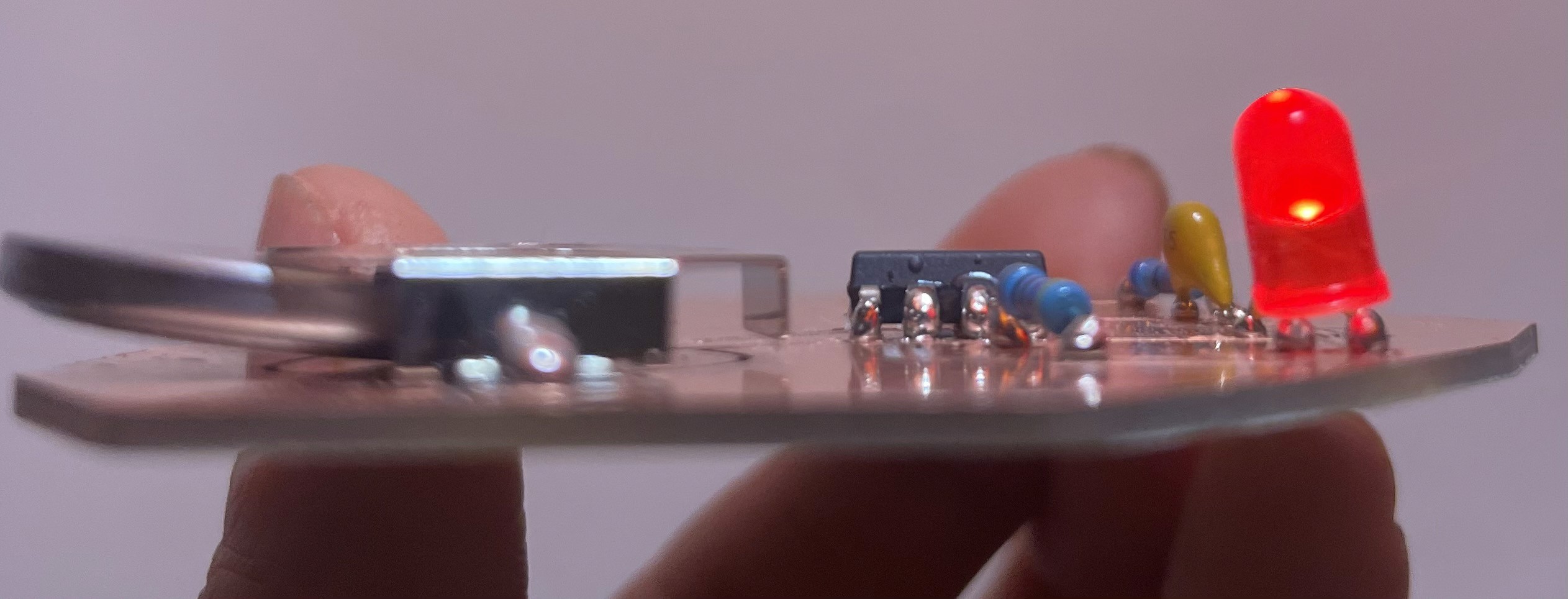
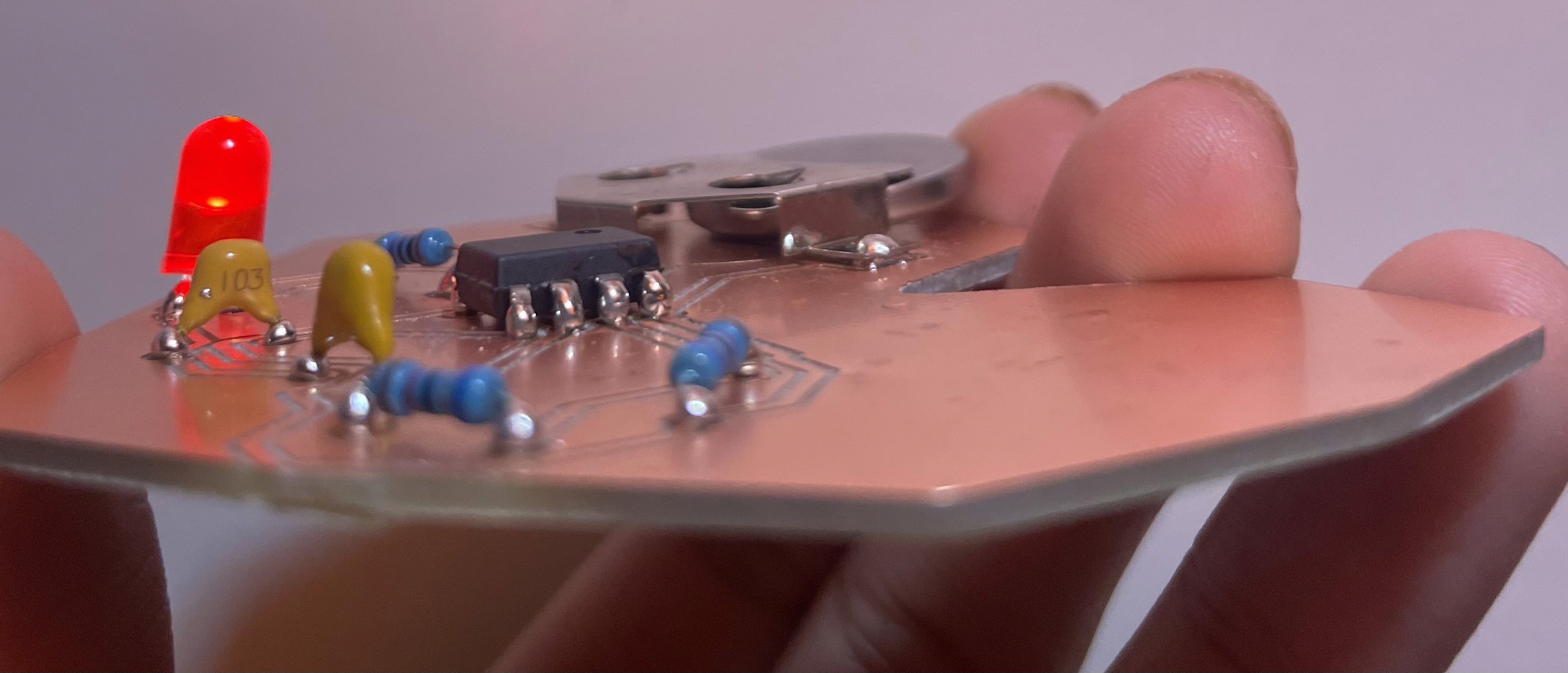
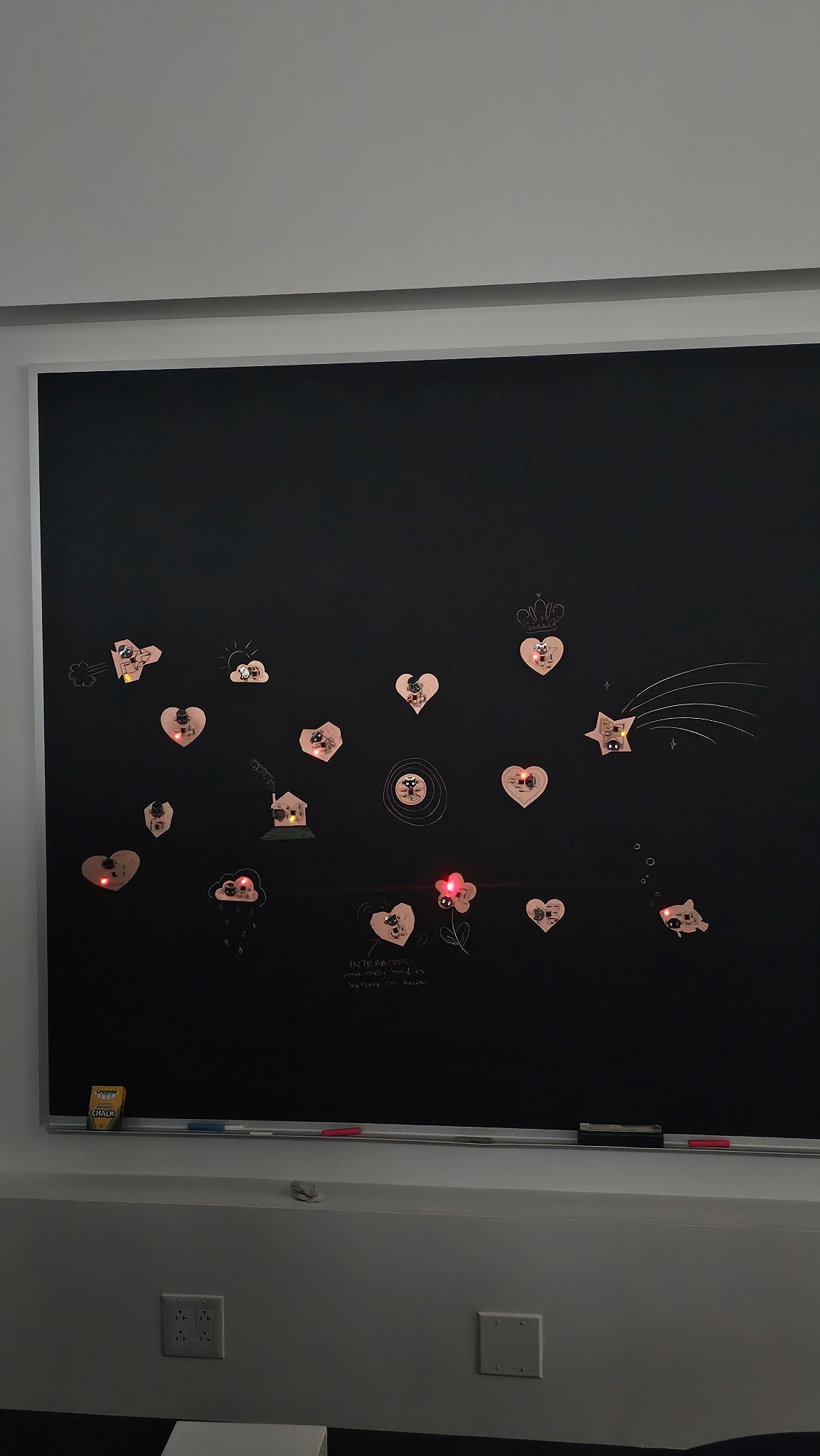
featuring all my classmates
COOL DESIGNS TOO!✨
featuring all my classmates
COOL DESIGNS TOO!✨
I chose a heart in honor of Valentine's Day — but not just because of the holiday itself, because of what the holiday represents.
I think the reason people love and hate Valentine's Day is because it's one of the only times of year when vulnerability is not just acceptable, but encouraged. To show love is to make yourself completely open. The heart symbolizes vulnerability, growth, and rawness.
But here's what I kept thinking while building this: Valentine's Day is kind of like an artificial heart.
It was created to celebrate love — but somewhere along the way, it became a placeholder. One designated day to finally open up our hearts, and then close them back up. An artificial heart tries its hardest to imitate a real one — the beat, the rhythm, the warmth — but at the end of the day, it's standing in for something it can't fully replace.
And yet, the artificial heart keeps people alive. It buys time. It holds space until something real can take over.
Maybe that's enough to start with.
I think the more we practice opening up — showing love, showing empathy, showing our real selves — the less we need a designated day to do it. One artificial day can slowly become something more human. That contradiction is exactly what I'm trying to carry through this portfolio: that something cold and mechanical can hold something deeply alive. We just need to look at it from a different angle. ❤️
REFLECTION
💭
Thank you to TA Mark for holding extended office hours, so we could finish our projects in time!!!🙌
And of course, since it's Valentine's Day, thank you to my family and friends who inspired this project, and show me Valentine's Day every day! :)
Happy Valentine's Day!!!
THANK YOU!
💌