Made locally— loved locally
Helping NYC residents act early and confidently
during floods through trusted local coordination.
Role
Product Designer
Tools & Skills
UI/UX, User Research, Product Development, Mobile Design, Product Strategy, Prototyping
Team
HCDI Team 9 | Section 2
Anuraag Pandhi, Siyi Sun, Yan Wang
skip to final designs
When floods hit New York City, the problem isn't awareness — it's knowing what to do next. Doorstep is a local coordination app that connects residents to a small cluster of nearby neighbors, gives them tailored preparation checklists, and enables real-time safety check-ins during emergencies.
Built for new NYC residents in flood-prone neighborhoods like Red Hook and Gowanus, Doorstep turns scattered alerts into coordinated action — before, during, and after the storm.
🔍
PROBLEM SCOPE
Floods disproportionately affect New York City residents in peripheral neighborhoods like Red Hook and Gowanus — areas defined by high population density, urbanized infrastructure, and coastal exposure. Many new graduates settle in these neighborhoods due to lower rent, but arrive without an established community. They don't know their neighbors, they're unfamiliar with local risks, and they have no shared protocol for getting help when things go wrong.
During floods, communities are what keep people safe. Neighbors share real-time information, check in on each other, and fill critical gaps while official systems catch up. But new residents are cut off from this. They have fewer trusted channels, no local information hubs, and fragmented networks that break down exactly when they're needed most.
PROBLEM STATEMENT
New NYC residents in flood-prone neighborhoods lack access to the trusted local networks that make coordinated action possible during emergencies — leaving them isolated, overwhelmed, and unable to act when it matters most.
USER RESEARCH
User Interviews
We spoke with three recent movers to flood-prone NYC neighborhoods — Red Hook and Gowanus — to understand how people discover information, who they turn to during emergencies, and what stops them from acting on alerts.
Across all three participants, a consistent pattern emerged: people wanted to reach out during a crisis but had no one nearby to reach out to. Trust wasn't about familiarity — it was about shared reality. A neighbor two floors down felt more credible than a close friend calling from another city. At the same time, unstructured neighbor networks felt unreliable. What users wanted wasn't more communication — it was a clear, dependable protocol.
💬
"Even if I don't know them well, them being nearby makes it feel more real."
"You don't know whether your neighbors would respond… you can't rely on it."
"If there's no moderator, no trusted layer — it starts to feel noisy. And in an actual emergency, that's not enough."
USER QUOTES
Four Key Insights:
1
2
3
4
Alerts don't lead to action
New residents are structurally isolated
Proximity drives trust
People receive warnings but have no clear next step.
Users want to know someone will respond — not just that someone is nearby.
They lack the informal networks long-term residents rely on.
Trust requires reliability, not just presence
Nearby neighbors feel more credible than distant contacts during a shared crisis.
Key Insight Moving Forward: Connection Before Crisis
The problem isn't awareness — it's structured access to people you can act with. New residents don't need more alerts. They need a dependable local network that exists before the emergency, so they're not building trust from scratch when it matters most.
Competitive Analysis
We mapped the existing landscape of tools people use during flood emergencies to understand where the gaps were and what Doorstep needed to do differently.
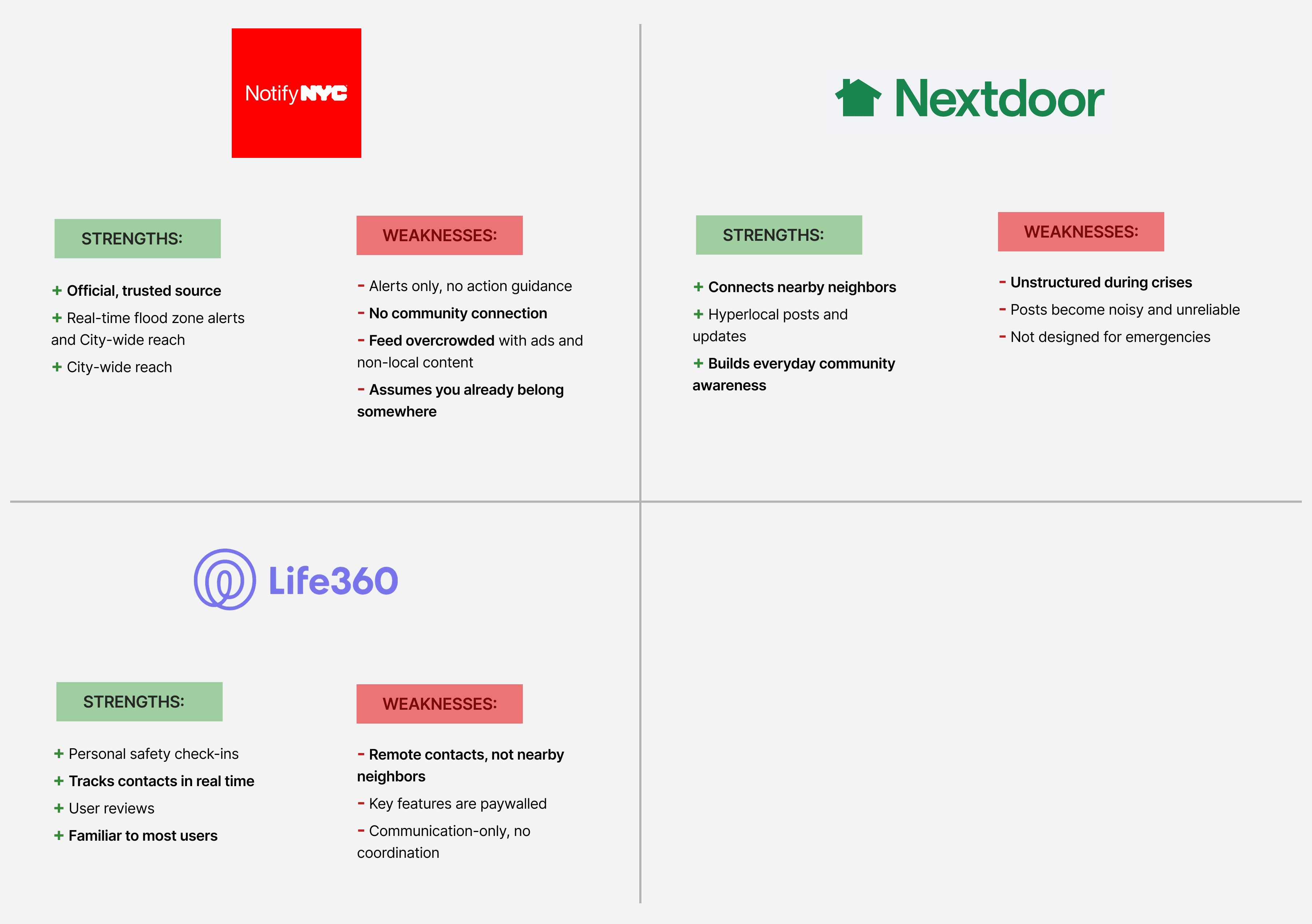
Notify NYC, Nextdoor, and Life360 all provide information or communication — but none of them were built for coordinated local action under stress. They connect people to alerts, or people to distant contacts, but not neighbors to each other in a structured, dependable way.
That's the gap Doorstep fills. Nearby neighbors have a voice — a shared status, a checklist, a protocol. And instead of noise, residents get clarity.
Concept Testing
Before committing to Doorstep, we tested three competing concepts with participants to evaluate which approach best supported coordinated action under stress. Each concept represented a different model of trust and support.
Doorstep — a local cluster of 5–10 nearby neighbors with a shared protocol and structured status signals.
Network — a hybrid system combining nearby locals for real-time ground conditions with remote contacts for research and coordination.
Evacuation Pass — an AI-guided personal agent that walks users through evacuation step by step with a countdown and route guidance.
We asked participants to rate each concept on two dimensions: trust and speed of response.
What we found
Doorstep consistently scored highest on trust. Participants felt that physical proximity — even among strangers — created a sense of shared reality that remote contacts and AI systems couldn't replicate. Network scored well on trust but lost points on speed, since distant contacts couldn't act in real time. Evacuation Pass scored well on speed but users were reluctant to rely on it alone, wanting human confirmation before acting.
"Ideally I'd want fast guidance from Pass, confirmed by people I trust." — Sruthi
"Network and Doorstep are similar in trust and speed — I'd rate both high." — Lisa
"If there's no trusted layer checking what's real, it starts to feel noisy." — Stan
Key Insight: Trust wins when stakes are highest.
We chose Doorstep because trust is the prerequisite for action. Speed matters, but users won't act on signals they don't believe. A nearby neighbor experiencing the same flood is the most credible source of all — and Doorstep is the only concept built around that.
FINAL PRODUCT (TA-DA!)
🪄
Doorstep helps new NYC residents act early and confidently during floods through trusted local coordination.
It automatically connects you to 5–10 nearby neighbors when you move in — before any emergency. When a flood warning hits, it sends you a personalized checklist based on your floor and flood zone. And when flooding begins, a single tap signals your safety status to your cluster, while verified shelters and resources surface in real time.
Three modes. One goal: turn scattered alerts into coordinated local action.
We made a video of our app. Click to watch!
Thank you to Professor Harry West for an amazing semester. This course opened my eyes to human-centered design and what it means to build products that truly serve people's lives and needs.
Thank you also to the TAs for all your support throughout. Cheers to the summer!
THANK YOU! ◡̈